FULL STORY:
The Photograph That Changed Everything
The first thing Mia Rivera noticed wasn’t the money.
It was the photograph.
Morning light spilled through the wide glass windows of Golden Spoon Bistro, painting everything in warm gold. Mia moved quickly between tables, balancing plates and polite smiles like she always did. To customers, she was just another waitress working the breakfast rush—efficient, friendly, invisible in that particular way that service workers become invisible in spaces where they move every single day.
But inside, Mia carried a quiet ache that had been with her for two years, growing heavier with each birthday and holiday and ordinary Tuesday morning that passed without the person she needed most.
Her mother, Elena Rivera, had died two years ago—peacefully, in a hospital bed, holding Mia’s hand. Her last words had been simple, practical, the way Elena had always been: “Take care of yourself. Be brave. And don’t be angry with people for being human.”
But Elena had taken secrets with her. So many secrets.
The biggest secret had a name that Mia would never know, a face she would never see, a story that remained locked away in her mother’s careful silence.
Her father.
Elena had never explained. Growing up, whenever Mia asked—and she had asked, in that persistent way children have—Elena would gently brush her hair back and whisper, “Some stories are better left in the past, mija. Some things are too complicated for a simple answer.”
“Then give me a complicated answer,” young Mia had replied, frustrated.
But Elena would just smile sadly and change the subject, and eventually, Mia had learned to stop asking. She had learned to accept that some people came into the world incomplete, missing a piece that other children seemed to have. She had learned to live with questions that would never be answered.
Mia never believed Elena’s assertion that those stories should stay in the past. She believed her mother was protecting her from something, or perhaps protecting someone else. But the truth remained sealed, and Mia had made peace with that truth—or so she thought on this ordinary Tuesday morning when she clocked in at six-thirty AM and tied her apron and prepared herself for another day of being unseen.
The man who entered didn’t belong to the usual crowd.
Mia knew the regulars. There was Margaret, who came in every Tuesday and Thursday for scrambled eggs and wheat toast and always asked about Mia’s schooling. There was Tom, who worked construction and ordered the same omelet—ham, cheese, mushrooms, peppers—without ever having to specify. There were the retired couples, the business people on their way to offices, the students stealing an hour before class.
But this man was different.
He was tall, well over six feet, sharply dressed in a charcoal suit that looked expensive without being ostentatious. His posture was calm but commanding, the way people carry themselves when they are used to having their presence acknowledged. He was older—mid-fifties, Mia guessed, with dark hair threaded with gray at the temples, and features that were refined, sculpted, the kind of face that belonged in boardrooms rather than breakfast diners.
When he walked through the door, the room seemed to shift around him in a subtle way that Mia couldn’t quite explain. Not because he demanded attention, but because his presence had a kind of weight to it, an inevitability, as though the universe was making space for him to exist.
Mia greeted him with her standard warmth, seated him by the window—he had requested the window without asking, and she had known somehow that that was what he wanted—and took his simple order. Black coffee. Egg white omelet. Whole wheat toast. Nothing fancy. Nothing that required complicated preparation or special attention.
There was something about him that made her chest tighten.
As she walked away, Mia tried to place what it was. She was good with faces, good with reading people—you had to be in her line of work. You had to learn quickly who would tip well and who would be difficult. You had to develop an intuition about human nature that allowed you to navigate the complex dynamics of service and dignity.
But this man was different. His familiarity was not the familiarity of having seen him before. It was something deeper, something coded into her bones, something she could not quite access.
She told herself she was imagining things. Projecting. There was a psychology term for this—pareidolia, but for people, for history, for the things we desperately wanted to find. Her mother had been dead for two years. She was lonely. She was reaching for connections that didn’t exist.
She returned to the kitchen and prepared his order. The eggs cooked perfectly. The toast came out golden. She plated everything with the care she brought to every plate, because she had learned from her mother that dignity mattered in small things, that the way you did small things mattered, that even people no one else was paying attention to deserved to be treated with respect.
When she walked past his table again, returning with her next round of orders, the man opened his leather wallet.
He was looking for something—a credit card, perhaps, or cash to place on the table before his food arrived. A habit of orderly people. He opened the worn fold, and as he did, something spilled out slightly—old, creased, softened by time and handling.
A photograph.
Mia froze.
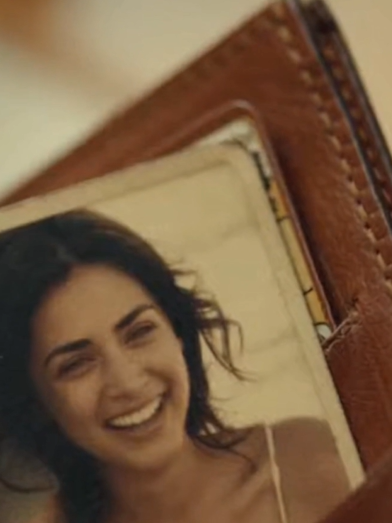
The photograph was small, the kind of size photographs used to be before everyone started carrying thousands of them on their phones. It was slightly creased, as though it had been handled a thousand times, folded and unfolded, looked at and put away, carried through decades like a secret that was too important to lose but too painful to discuss.
The woman in the picture was younger than Mia had ever known her mother to be. Younger than the wedding photo that had sat on their living room shelf. Younger than the pictures from Mia’s childhood, when Elena was still in her thirties.
But there was no mistaking the face.
It was her mother.
It was Elena Rivera, and she was smiling in a way that Mia had rarely seen—a full, open smile, the kind that reached the eyes, the kind that suggested joy so complete it was almost abandonment, as though the person smiling had forgotten to be careful, forgotten to protect something.
Elena’s hair was longer in the photo, and she wore a dress that Mia didn’t recognize, something flowy and light, and she was leaning against someone, her head tilted in a gesture of intimacy and trust.
Her head was tilted toward the person taking the photograph, or toward someone just outside the frame.
For a moment, the world went completely silent.
The clatter of dishes in the kitchen faded away. The low hum of conversations at other tables—Margaret’s laugh, the murmur of business people discussing meetings—everything faded beneath the roar of her own pulse.
Mia’s hands began to shake.
She gripped the tray she was carrying a little tighter, and somehow, by pure force of will, she made it to the table she was supposed to reach. She set down the food. She smiled. She said the words she was supposed to say: “Will there be anything else?” She performed the role that had become so automatic it felt like the only reality she had access to.
But her mind was elsewhere.
Her mind was asking questions that had no answers. Her mind was reaching backward through twenty-two years of her own life, trying to understand what this meant, what it could possibly mean, that her mother’s photograph—this intimate, tender photograph of her mother in a moment of happiness that Mia had never seen her experience—was being carried in a leather wallet by a stranger in a charcoal suit.
She finished her circuit of tables. She stayed busy. She filled coffee cups and took orders and moved through the space like she was supposed to move through it. But her eyes were drawn back to that table, to that man, to the wallet that was now closed, the photograph carefully secured again in its worn fold.
And when she could no longer justify staying away, when her section of the restaurant had been served and checked on and there was nothing left to do but the thing she was terrified of doing, Mia slowly turned back to the table.
The man was waiting. He was looking out the window at the street, at the morning traffic, at the ordinary world continuing on around them. He was calm. Patient. The way people are when they are used to waiting for things they want.
Mia approached the table. Her voice, when she spoke, barely sounded like her own.
“Sir… may I ask you something?”
The man turned to her. His eyes were a warm brown, almost amber in the morning light. They were kind eyes. Sad eyes. Eyes that held their own stories, their own secrets, their own carefully guarded hopes.
“Of course,” he said.
Her hand trembled as she spoke. She pointed to the wallet that was now folded on the table beside his plate.
“That photo… the woman in it…” She swallowed hard, her throat tight. “Why is my mother in your wallet?”
The man’s expression changed instantly.
Color drained from his face. The warmth in his eyes seemed to deepen into something almost like shock, or maybe like recognition, or maybe like the moment when something you have been waiting for comes finally, finally true.
Slowly—very slowly—he looked down at the photograph that was still partially visible in the wallet. Then he looked back up at her.
And when he finally spoke, his voice was barely above a whisper, and it was the voice of a man confronting a truth so significant that the words themselves seemed inadequate to hold its weight.
“…Because I’ve been searching for you for twenty-two years.”
The world tilted.
Mia sat down at the table without being invited, moved by some instinct that was older and stronger than propriety or professionalism.
“What’s your name?” she asked.
“David,” he said simply. “David Moreno. And I’m… I’m your father.”
The words hung in the space between them like something physical, something that had its own gravity and mass and the ability to reshape everything around it.
Mia’s vision blurred. She had spent so many years not allowing herself to wonder about this person, not allowing herself to imagine what he might be like, not allowing herself to hope for a story that might be different from the narrative of abandonment that she had come to accept. And now, suddenly, here he was, and he was not what she had expected, but he was real.
“My mother never told me,” Mia said.
“I know,” David replied. “I didn’t find out until it was too late. By the time I knew you existed, your mother had made a choice. She wanted to protect you from something. From my past, I think. From complications. From the fact that I was married when we met.”
He didn’t ask for forgiveness. He didn’t make excuses. He simply stated facts like a man who had spent twenty-two years accepting the consequences of his choices.
“I’ve spent every year since looking,” he continued. “Quietly. I didn’t want to intrude on your life. But I couldn’t stop. You were my daughter. You were out there somewhere, and I couldn’t stop wondering about you, couldn’t stop thinking about the time I was missing, couldn’t stop carrying this photograph and remembering your mother’s smile.”
Mia found herself crying, tears spilling down her face before she even fully understood what emotion was causing them. Was it anger? Relief? Grief? Hope? It was all of these things and none of these things. It was the feeling of a puzzle piece falling into place. It was the feeling of a story finally making sense.
“Why were you here?” she asked. “At this restaurant? Out of all the places in the city, why today?”
David smiled sadly. “I wasn’t supposed to be here. I was driving past, and I remembered that your mother had mentioned once, years ago, that she dreamed of opening a restaurant. Something with good food and warm light and a place where people who felt invisible could feel seen. I was remembering that dream, and I looked up, and there it was. Golden Spoon Bistro. And I thought, ‘Maybe.’ Just maybe.”
“It’s my restaurant,” Mia said quietly. “I mean, I work here, but I’ve been saving for five years to buy it. My boss is retiring next year. He promised me first option.”
David’s eyes filled with tears.
“Your mother always said you were going to change the world,” he said. “She said it when you were a baby. I didn’t get to know her, but I could tell from the way she talked about you that you were going to be something extraordinary.”
What followed was a conversation that lasted four hours.
Mia called her manager, explained that she needed to leave. She didn’t explain why. She didn’t know how to explain that the ground beneath her feet had shifted, that the world she had thought she understood had transformed into something much larger and more complicated.
David told her about her mother. He told her that Elena had been brilliant—a chef, a dreamer, a woman with ambitions that the world had not quite made space for. He told her about the brief, impossible moment they had shared. He told her that when Elena had cut him out of her life and out of the life of her daughter, he had respected that choice, but he had never stopped honoring it by carrying her photograph, by remembering, by searching quietly for the child he had never gotten to know.
Mia told him about herself. She told him about her mother’s final years, about the restaurant, about her dreams of creating the exact kind of space her mother had described—a place where people who felt invisible could be seen.
By the time they stood up from the table, the lunch rush was beginning. The restaurant had filled with new people, people who had no idea that one table had been the site of a transformation.
David reached into his jacket and pulled out a business card.
“I’m a developer,” he said. “I work with restaurants, with small businesses, with people trying to build something. Whatever you need—financing, consultation, support—I want to be part of this. Not because I’m trying to make up for lost time. You can’t make up for that. But because your mother’s dream deserves to exist, and I think you’re the person who can make it happen.”
Mia took the card. Her hand was steady now.
“I need to think about this,” she said.
“I know,” David replied. “Take all the time you need. But Mia?” He paused, and in that pause was the weight of twenty-two years. “I’m not leaving. I’m not going anywhere. Not anymore.”
Over the following weeks, Mia learned the story of her parents’ relationship—brief, impossible, and ultimately impossible to sustain. She learned that David had been unhappy in his marriage long before he met Elena, but that he hadn’t had the courage to leave until Elena had already left him.
She learned that David had spent decades building a successful career partly because he was talented and partly because work was easier than facing the absence of a daughter he would never know.
She learned that her mother had made her choice out of love—to protect Mia from the complications of having a father who was untangling himself from another life, to give Mia a story that was at least coherent, even if it was incomplete.
Mia and David built a relationship that was not quite normal—it couldn’t be, not after twenty-two years of separation. But it was real. It was genuine. It was built on the foundation of his respect for her autonomy and her mother’s memory.
And when Mia opened her restaurant—her own place, a space called Elena’s Table, in honor of the woman whose dream had started everything—David was there on opening night. He sat at a table by the window, the same table where their reunion had begun, and he cried quietly as his daughter moved through the space she had created.
The restaurant became known for something unusual. It wasn’t just the food, though the food was excellent, infused with the recipes and traditions Elena had passed down to Mia before she died.
It was the atmosphere. It was the way Mia treated every person who came through the door—whether they were wealthy or poor, noticed or invisible, people with families or people alone. She saw them. She made them matter.
And on the wall beside the door, there was a photograph. It was the photograph of Elena, the same one David had carried for twenty-two years, framed now and preserved, a testament to the moment when a young woman had smiled at the camera with all her dreams still intact.
Beneath it, a small plaque read: “For my mother, Elena Rivera, who dreamed of creating a space where invisible people could be seen. And for my father, who never stopped searching.”
Years later, when Mia was interviewed about her restaurant’s success, she would talk about food and ambiance and the importance of making people feel valued.
But if pressed, she would always come back to the same answer: “It all started with a photograph. With someone carrying a memory. With two people finding each other when both of them had given up hoping they would.”
The photograph that David had carried for twenty-two years hung on the wall of Elena’s Table because Mia understood something fundamental about love: it doesn’t end. It just transforms. It goes from presence to memory, from touch to photograph, from certainty to faith.
And sometimes, if you’re very lucky, if you make the right choices and someone else has made brave choices before you, it transforms again into something new.
Mia would often think about the odds of that particular Tuesday morning. How David could have driven past any restaurant in the city but had chosen that one. How Mia could have missed seeing the photograph, could have passed him by without looking back, could have dismissed the instinct that made her chest tighten when she first saw his face.
How many moments like that existed in the world? How many people were walking past the people they should have known? How many stories never got told because someone didn’t take the chance?
She had taken the chance. David had taken the chance. And in taking it, they had honored Elena’s memory by becoming the exact thing she had hoped Mia would become: people who saw.
Leave a Reply