FULL STORY:
The Moment Power Crumbled
At dawn, the parade ground at Camp Pendleton had that almost theatrical stillness you only see before something important happens, when the air is cold enough to sting the inside of your nose and the rows of Marines stand so precisely aligned that the entire base looks as if it has been pressed flat with an iron. Boots squared. Chins lifted. Flags snapping hard against a Pacific wind that carries the smell of salt and jet fuel in equal measure.
If you didn’t know better, you might think discipline was a permanent condition rather than something fragile that must be defended every single day.
There were close to two thousand Marines assembled that morning, their formation stretching wide across the concrete like a living grid. Officers were stationed along the perimeter. Enlisted ranks locked in posture, every person a component of a machine designed to function without question, without deviation, without the complication of individual thought.
And at the center of that controlled symmetry stood a woman who, at first glance, seemed entirely out of place, as though she had wandered into the wrong ceremony by accident.
Her name was Mara Ellison. Twenty-seven years old. Slight in build. Dark hair pulled back in a low knot that emphasized the sharp angle of her jaw. She was dressed not in uniform but in a charcoal blazer over a pale blouse, a contractor badge clipped neatly at her waist—the kind of badge people glance at and dismiss in the same second. Because contractors are background figures, necessary but invisible. And invisibility is a useful cover when you’re not there for applause.
Mara had been escorted in by Colonel Nathaniel Cross, whose expression had been carefully neutral from the moment they stepped out of the staff vehicle. Just before they reached the edge of the formation, he had leaned slightly toward her, not enough to draw attention, and murmured: “Stay close to me, and whatever happens, you do not react.”
Mara had nodded once. Not because she was intimidated, but because she understood optics. And optics were part of her job.
Her real job.
What the badge didn’t indicate was that Mara Ellison was a federal investigator with the Office of Inspector General, embedded in this ceremony to observe, document, and evaluate leadership at the highest levels. She had been detailed to Camp Pendleton for three weeks, conducting interviews, reviewing operations, assessing whether the command climate reflected the values the military claimed to uphold.
Her reports would be classified. Her observations would influence policy decisions made at the Pentagon. Her presence was unknown to all but a select few—and Rear Admiral Clayton Pierce was not among them.
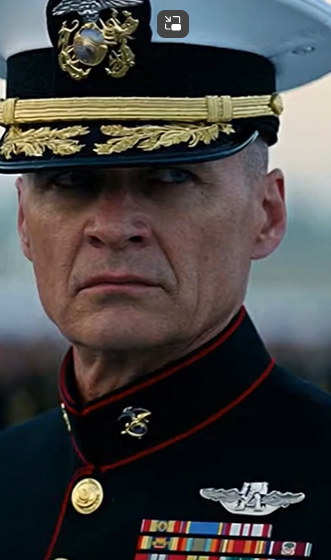
Pierce entered the field with the confidence of a man who believed the morning belonged to him. His dress uniform was immaculate, ribbons aligned with mathematical precision, his stride unhurried yet deliberate. He was the kind of leader whose reputation preceded him in whispers—sharp-tempered, uncompromising, a disciplinarian who mistook fear for respect and had built a career on the subtle intimidation of those beneath him while carefully cultivating alliances above.
He had been featured in military journals. His name circulated in discussions about the future leadership of the Navy. He had positioned himself as the strict voice, the one willing to demand standards when others grew soft.
He was mid-speech when his gaze snagged on Mara, his eyes flicking from the formation to the unfamiliar silhouette near Colonel Cross. For a second his cadence faltered, not because he was uncertain but because he was calculating. He was trying to understand who this woman was and what her presence meant.
He stepped down from the reviewing platform and walked toward her with a measured pace that carried its own message—the kind of approach that says this is my ground and you are trespassing.
“Colonel Cross,” Pierce said without looking at him, “why is there a civilian standing in my formation?”
Cross straightened, his voice professional and controlled. “Sir, she is present under authority—”
Pierce cut him off with a raised palm, sharp and dismissive. “I didn’t ask for your clarification.”
His eyes settled on Mara, traveling from her badge to her face, lingering just long enough to convey disdain. There was something in his expression that suggested he was used to women reacting to his authority with deference, with a kind of grateful obedience. He was not used to being questioned. He was not used to women standing in his formation without his explicit permission.
“And what exactly are you supposed to be?” he asked, his tone carrying the weight of someone accustomed to verbal sparring and confident in his ability to win.
“Mara Ellison,” she replied, voice level and clear. “Department of Defense oversight.”
He laughed once, not amused but contemptuous. The laugh was designed to establish hierarchy, to make it clear that he found her claim ridiculous. “Oversight? They’re sending interns now?”
A ripple moved through the front ranks, subtle but real. The kind of shift that happens when something feels off but no one is allowed to acknowledge it. Marines are trained to maintain formation, to suppress reaction, but they are still human. And humans sense when something changes in the air.
Mara met his gaze without flinching. She understood what was happening. She understood that this was a test, that Pierce was probing the boundaries of her authority, determining how far he could push her before she would assert whatever credentials she claimed to have.
She decided to establish a line.
“Sir, you need to maintain professional distance,” she said, her voice calm, almost gentle.
But gentleness is a kind of power too. And sometimes gentleness is more threatening than aggression because it suggests someone who is so certain of their position that they don’t need to shout.
The words ignited him.
Pierce’s face hardened in a way that suggested he had not been spoken to that way in years, if ever. In one swift, impulsive motion—the kind of motion that comes from a man accustomed to having his authority never challenged—he lifted his hand and struck her across the cheek.
The sound was sharp and unmistakable against the morning stillness, echoing across two thousand Marines who had been trained not to move, not to react, not to let their faces betray surprise.
There are moments when time elongates, when you can feel the exact second the atmosphere shifts from ceremony to crisis. This was one of them.
Mara’s head moved with the force of the slap, her hair loosening slightly at the nape, a bloom of red rising instantly along her cheekbone. For a heartbeat it looked as though she might stagger. But instead, she straightened slowly, deliberately, her shoulders settling back into alignment, her eyes not blazing with anger but narrowing into something colder, more focused.
Colonel Cross inhaled sharply. “Admiral—”
“She disrespected me in front of my Marines,” Pierce snapped, his voice loud enough to carry across the formation. He was already preparing his narrative, already beginning the process of reframing what everyone had just witnessed.
Mara touched her cheek once, not in shock but as if confirming a data point. Then she lowered her hand.
“No,” she said, her voice carrying cleanly across the nearest ranks, steady and precise. “You assaulted a federal official in front of two thousand witnesses.”
The word official landed differently than contractor. It landed like a detonation.
“Federal?” Pierce’s expression shifted from aggression to confusion to something like concern. His mind was already calculating the implications. “You’re not—”
“Marine Captain Rodriguez,” Mara said, her gaze fixed on a junior officer standing rigidly at attention in the front rank, “please step forward and secure the admiral until proper authorities arrive.”
What happened next was the kind of thing that sometimes appears in military history textbooks as a turning point, a moment when the machinery of institutional power suddenly revealed its own internal constraints.
Because Captain Rodriguez, who had been trained to follow orders, who had been conditioned to respond immediately to command, followed this one without hesitation. He moved from the formation with two other officers, and before Pierce fully understood what was happening, he was being physically restrained—not roughly, not with any disrespect for his rank, but with the absolute certainty of institutional protocol being enforced.
“This is insane,” Pierce said, struggling slightly against the hands on his arms. “I am a rear admiral—”
“You are a rear admiral in violation of the Uniform Code of Military Justice,” Mara said, and her voice now carried a kind of official clarity that made it clear this was no longer a conversation but a statement of fact. “You have assaulted a federal investigator. In front of two thousand witnesses. On a recorded ceremony broadcast to command centers across the Pacific Fleet.”
The broadcast. There was always a broadcast. Military ceremonies of this magnitude were always streamed, always documented, always stored in servers that could be retrieved and reviewed by anyone with the proper clearance.
Which meant that in the next few hours, every second of what had just occurred would be available to review in the Pentagon, at the Office of the Inspector General, at the Chief of Naval Operations, at every command center where people with authority would be watching a four-star admiral assault a young woman and then watch her reveal classified credentials that placed her at a level of institutional authority he had not anticipated.
It would become the kind of moment that circulated through military culture for years—not as gossip exactly, but as a kind of cautionary tale. The moment when authority revealed itself to be fragile, when a man’s assumed power was eclipsed by institutional structure, when decades of careful reputation-building was undone in the span of thirty seconds.
Medical personnel arrived to examine Mara’s injury. The mark on her cheek was photographed, documented, filed away as evidence. An ambulance was called, not because her injury was severe but because protocol demanded it. She was transported to the base hospital, where she was treated for a minor contusion and released within two hours.
By that time, Rear Admiral Clayton Pierce had been removed from his position pending investigation. His security clearances had been suspended. His access to classified materials had been revoked. And his name had been flagged in systems that would determine the trajectory of every future promotion, every future position, for the remainder of his career.
What followed was the kind of institutional reckoning that happens quietly, behind closed doors, without the public spectacle that sometimes accompanies military scandals. Pierce did not lose his rank immediately. The military does not discard people that easily, especially not people with decades of service and strong connections.
But he did lose his credibility. He did lose the respect of subordinates who had witnessed what he had done. He did lose the opportunity for advancement that he had been cultivating. And most significantly, he did lose the aura of invincibility that had protected his behavior for so many years.
Within six months, Pierce took early retirement. The announcement was brief, the language of official statements designed to obscure rather than clarify. He cited “personal reasons” and “desire to pursue other opportunities.” No one believed it. Everyone understood what had actually happened.
Mara Ellison’s investigation report, declassified years later, would detail not just the assault but the pattern of behavior that had preceded it. It would document complaints from junior officers, inappropriate command decisions motivated by personal vendetta, a climate of fear that had been systematically cultivated through intimidation and threat.
The report would recommend significant changes to command culture, improved training in leadership ethics, and the implementation of oversight mechanisms designed to catch this kind of behavior before it escalated.
Pierce’s case would become a teaching moment at military academies, a discussion point in leadership seminars, an example of what happens when someone mistakes authority for actual leadership.
But for Mara, the significance was simpler and more profound. She had been sent to observe. She had been positioned as an invisible oversight mechanism, someone whose role was to watch without being seen, to document without participation.
And instead, she had been forced to assert her presence, to step out of invisibility, to use her actual authority to stop something that was genuinely wrong.
Years later, when Mara had risen to positions of greater authority within the federal government, she would sometimes reflect on that morning at Camp Pendleton. She would think about the moment she decided to establish a line, to not allow herself to be humiliated in service of her investigation.
She would think about the choice to speak, to assert her presence, to not remain invisible while something wrong was happening in front of two thousand witnesses.
And she would understand that sometimes the most important work is not done in silence, not done from behind the scenes, but done loudly and clearly, with the full weight of institutional authority behind it.
The morning at Camp Pendleton became part of military folklore, though not always in the way Pierce had imagined his presence would be remembered. He had entered the field expecting to consolidate his authority. He had left it stripped of the illusion that authority is anything other than a fragile social construct, dependent on the consent of those below you and the support of those above you.
Mara Ellison had entered as a contractor, invisible and peripheral. She had revealed herself as a federal official with the power to enforce institutional accountability. And in doing so, she had demonstrated something that Pierce had never understood: that true authority is not derived from rank or position or the ability to intimidate subordinates.
True authority comes from the willingness to enforce standards that apply to everyone, equally, regardless of their position in the hierarchy.
The photograph of Mara Ellison’s face the moment after the assault was eventually released to the media through official channels. It showed a young woman with a visible injury, standing with perfect posture, her expression composed and clear-eyed.
It became an image that circulated in military culture as a reminder that someone with actual authority had stood still and absorbed an attack rather than reacting defensively, and then had calmly asserted the institutional power to hold someone accountable for their actions.
It became, in many ways, the visual representation of what institutional accountability looks like when someone is willing to stand in the light and assert their actual position rather than remaining invisible.
Rear Admiral Clayton Pierce retired to a quiet life outside of military service. He gave no interviews. He made no public statements. He became, in many ways, what he had feared most—invisible, forgotten, a cautionary tale rather than a commanding presence.
And Mara Ellison went on to a career that would eventually place her in positions where she could shape policy, where she could enforce standards across the entire federal establishment, where she could ensure that people in positions of authority understood that their power was conditional, dependent, and subject to oversight.
The morning at Camp Pendleton had started with a man who believed his authority was absolute and permanent.
It ended with the understanding, crystal clear and undeniable, that no authority—no matter how carefully cultivated, no matter how well protected by relationships and alliances—exists outside the bounds of institutional accountability.
Leave a Reply