FULL STORY:
The Moment Love Chose Dignity
There are moments when the world seems to stop breathing, when time stretches so thin that every heartbeat becomes loud enough to feel in your throat, and that was exactly what happened outside the dusty entrance of City Mart Plaza one warm afternoon, where street vendors shouted prices, tired mothers dragged their children along, and no one expected life to spin upside down because of one woman stepping out of a car.
Not just any woman.
Isabella Reed.
The youngest billionaire CEO in the state. Founder of ReedTech Innovations. A single mother whose name appeared regularly in business journals and lifestyle magazines. A woman whose confidence wrapped around her like silk, visible in every movement, every decision, every photograph taken at charity galas and technology conferences.
She had built her empire from nothing—starting with an idea, building it with late nights and impossible odds, raising her daughter Sofia alone while climbing to heights that most people could only imagine. She was the woman other women referenced when they talked about what was possible, about breaking through ceilings, about defining success on your own terms.
On this particular afternoon, she stepped out of her sleek black Rolls Royce in a cream tailored jumpsuit that flowed with power. Her heels clicked against the concrete. Her long dark hair caught the wind just enough to look cinematic. And as people whispered her name like a headline come alive, she did something completely unimaginable.
She walked toward a homeless man sitting near a pile of worn crates.
Most people never notice homeless people. They pass by them every day without seeing them, without registering them as real, their brains trained to filter out the uncomfortable, to move past suffering without acknowledging it. But Isabella had always been the kind of person who saw what others ignored.
This man was barely noticeable on most days, just another invisible life ignored by hundreds. His coat was frayed at the sleeves. His shoes were so worn they barely resembled footwear anymore. His beard was unkempt, his hair wild, his eyes distant like someone who’d forgotten how to look at the world because the world had forgotten him first.
But Isabella saw something in him.
She had been coming to this plaza for weeks, stopping by a coffee vendor who operated near the entrance, and during those weeks she had heard him speak. Not constantly—he was quiet mostly—but occasionally he would engage in conversations with other homeless people, and when he did, he would talk about economics, about coding, about complex systems and market dynamics, about the intricate patterns that governed how money moved through the world.
He talked like someone who had once understood these things deeply. Like someone who had lived in that world before falling out of it.
When Isabella stopped in front of him, it took him several seconds to even lift his gaze. It was as if he couldn’t quite believe that someone was standing there, actually talking to him, actually addressing him as though he were a real person worthy of attention.
“My name is Isabella,” she said softly, her voice warm but trembling with something hidden beneath the confidence.
His voice cracked slightly when he replied, broken from disuse. “Logan Hayes.”
What came next surprised everyone—the gathering crowd, the vendors, even Isabella herself, though she had rehearsed this moment a thousand times in her mind, playing it over and over until she had found the courage to actually do it.
“I’ve heard you speak sometimes,” Isabella said, swallowing hard. “You talk about economics and coding and systems like someone who once commanded boardrooms, not benches on sidewalks. I don’t know your past, and I don’t need to. I don’t know what brought you here or what circumstances broke your life. But I see your mind, and I see your dignity, and I believe second chances exist for a reason.”
She closed her eyes for a moment, gathering the last of her courage. When she reopened them, there was something different in her expression—something more vulnerable, more genuine, than the confident billionaire persona people knew.
“So I’m asking you something insane,” she continued, her voice steady despite the trembling in her hands. “Logan Hayes… will you marry me?”
Silence didn’t just fall. It crashed.
Phones came up. Jaws dropped. Somewhere a soda can rolled across the pavement and even that felt dramatic because nothing else moved. The world had literally stopped to witness this moment.
Logan just stared at her, trying to understand if life was mocking him or saving him. His eyes were confused, searching her face for some indication of what was real and what was a cruel trick his mind was playing on him. Then something shifted in his expression.
He smiled.
A tired smile. A broken smile. But full of dignity.
“If you mean that,” he whispered, his voice hoarse from months of not being heard, “go inside, buy a ring, come back, kneel… and ask me like it matters. Because I need to know I matter. Not as a charity case. Not as a story for people to tell. But as someone worth the effort.”
People gasped. Some laughed. Some were offended. How dare a homeless man challenge a billionaire? How dare he not simply accept what was being offered? But Isabella didn’t flinch. Didn’t hesitate. Didn’t show even a moment of doubt.
She turned and disappeared inside City Mart Plaza, leaving a crowd of confused onlookers whispering about what they had witnessed. Logan sat quietly on his crate, wondering if Isabella would actually come back, if this was real, if the world had genuinely shifted in some fundamental way.
She returned seven minutes later.
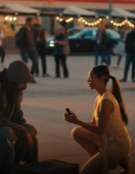
She was holding a small black velvet box. The diamond ring inside was substantial—not ostentatious, but undeniably expensive, the kind of ring that announced both wealth and taste. She walked directly to Logan and, without hesitation or performance, she knelt.
The crowd watched as a billionaire lowered herself to one knee in front of a homeless man on a public street.
Her hands shook, but her voice didn’t.
“Logan Hayes,” she said, her voice clear and strong, “I see you. I see a mind that deserves respect. I see a person that deserves dignity. I see someone worth fighting for. Will you marry me?”
Logan’s eyes filled with tears.
“Yes,” he whispered. “Yes.”
What happened over the following hours was the kind of story that breaks the internet, that circulates through social media like wildfire, that gets picked up by news outlets because it somehow captures something people desperately want to believe is possible.
Isabella produced documents—a marriage license application that she had prepared in advance. Within days, they were married by a judge who was familiar with Isabella’s philanthropic work and who understood the gravity of what was happening. No elaborate ceremony. No media circus. Just a commitment made by two people who had seen each other clearly and decided to build something together.
But the real story—the part that mattered most—was what happened after the moment of connection.
Isabella brought Logan to her home. She set him up in a guest house on her property, gave him space to process what had happened, offered him every resource he needed to reintegrate with the world: therapists, doctors, nutritionists, financial advisors.
She didn’t ask questions about his past. She didn’t demand explanations. She simply created a space where healing could happen.
Over time, Logan began to open up about who he had been.
He had been a software engineer at a major tech firm, making six figures, living the Silicon Valley dream. He had been married, or so he thought, until his wife left him for his business partner, taking custody of their daughter and erasing him from her life, claiming he was an unfit father due to his depression and anxiety. The legal battle had destroyed his savings. His reputation had been savaged. He had lost his job when the tech industry discovered his personal circumstances. He had spiraled into substance abuse and homelessness, becoming someone he barely recognized.
He had been invisible for five years.
And then Isabella Reed had seen him.
The wedding, when it became public knowledge, generated controversy. Some people called Isabella insane, foolish, reckless. They questioned her motives, suggested she was experiencing some kind of mental break, that no one in her position would marry a homeless stranger unless something was fundamentally wrong with her judgment.
Others celebrated it as an act of radical love, an example of what was possible when someone decided that dignity and second chances mattered more than convention.
But Isabella didn’t care what people thought. She had made a choice, and she stood by it completely.
Logan, reintroduced to the world as Isabella’s husband, began a slow process of rebuilding. He reconnected with his daughter, who was now a teenager and who was shocked to learn that her father was alive and trying to rebuild his life. His ex-wife, seeing that Logan was genuinely attempting recovery, softened her position. His daughter began to visit, cautiously at first, then more openly, then with actual affection.
Through Isabella’s connections, Logan was offered a consulting position at her company. He had expertise in systems architecture and coding that ReedTech needed. He wasn’t hired out of charity—he was hired because he was genuinely qualified and because his perspective offered value that the company had been lacking.
He excelled.
Within eighteen months, Logan had become a senior advisor at ReedTech. He was contributing to the company’s strategic direction. He was being featured in internal communications as a proof point that redemption was possible, that second chances could yield extraordinary results.
Isabella and Logan had a daughter together—a girl they named Hope. She was born into a family defined by acceptance, by the understanding that people’s pasts don’t determine their futures, that society’s judgment is not the final word on anyone’s value.
The couple became known not just for their marriage but for their advocacy work around homelessness and mental health. They funded programs designed to help people transition from homelessness to employment. They created scholarships for children of formerly homeless people. They spoke publicly about the systemic failures that allowed people like Logan to fall through every safety net.
Isabella’s daughter Sofia, now an adult, spoke in interviews about what it meant to watch her mother choose dignity over convention, to see her make a decision based not on what was expected but on what was right.
“My mom always taught me that success wasn’t about money,” Sofia said in one interview. “It was about being the kind of person who sees people. Who notices the invisible ones. Who chooses love over fear. When she married Logan, she showed me what that actually meant.”
Logan, in interviews, spoke about the moment Isabella knelt down.
“That image,” he said, his voice still carrying the roughness of someone who hadn’t used it much for years, “that moment when a billionaire kneeled in front of a homeless man and asked him to marry her, not because she was fixing him but because she had seen him—that changed my entire understanding of what human connection could be.”
Years later, Isabella and Logan were the subject of a documentary that explored themes of second chances, redemption, and the way that love can transcend the circumstances that society uses to separate people into categories of worthy and unworthy.
The documentary included footage from that day at City Mart Plaza, the moment when Isabella approached Logan, the moment when he smiled that tired, broken, dignified smile. It showed her inside the store, buying the ring with the kind of purposefulness that suggested this was not a spontaneous decision but something she had been contemplating carefully.
It showed her kneeling.
And it showed Logan’s tears when she asked him to marry her, when he said yes, when he understood that someone, finally, had chosen to see him.
The documentary became required viewing in some business schools as a case study in leadership and courage. It was shown in psychology classes as an example of what healthy love looks like. It circulated through nonprofits working on homelessness as proof that systemic change could come from individual choice.
But for Isabella and Logan, it was simply their life.
They had been given a moment where the world was watching, and they had used that moment to demonstrate something fundamental: that every person has value, that dignity is not a luxury for people with money, that second chances are real and possible and worth fighting for.
Isabella never spoke about her motivations for approaching Logan that day, never broke down the psychological journey that had led her to stand in front of a homeless man and propose marriage. She let the actions speak, let the choice stand on its own.
But in private moments, with Logan, she would sometimes reference the moment of kneeling.
“That wasn’t humbling myself,” she would say, “that was honoring you. That was saying, you matter enough to me that I will lower myself—not because you’re beneath me, but because love means meeting someone where they are and lifting them up together.”
Logan would listen to this, and he would understand that he had been given something that he had stopped believing was possible: a second chance that wasn’t conditional on who he used to be, a love that wasn’t interested in redemption stories but in actual redemption, a future that wasn’t built on forgetting the past but on integrating it into something whole.
The image of Isabella kneeling at City Mart Plaza became iconic, not because it was dramatic or sensational, but because it captured something essential about what it means to choose love in a world that often chooses judgment.
It became a reminder that billionaires and homeless men are not categories of human worth, but circumstances. That dignity is not earned through money or status but exists as a fundamental right. That second chances are possible when someone decides they matter enough to be fought for.
And most importantly, it became proof that sometimes the most radical act is simply to see someone clearly and decide that they are worth building a life with, no matter what society thinks.
Leave a Reply