FULL STORY:
The morning shift at Golden Spoon Bistro started like any other Tuesday. Mia had been working there for three years, long enough to know every regular’s usual order, every crack in the vinyl booths, every song on the jukebox that had played one too many times. She was twenty-four years old, a waitress by necessity rather than choice, carrying secrets that most people her age didn’t have to carry.
At least, she thought she did.
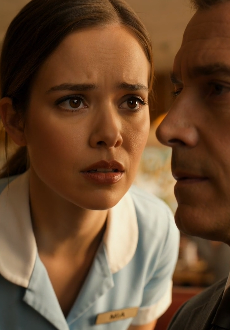
The diner was busy—the breakfast rush that turned the small restaurant on Fifth and Main into a controlled chaos of coffee cups, eggs over easy, and hurried conversations. Mia moved through it all with practiced efficiency, her black apron tied tight around her waist, her name tag catching the fluorescent light. She had learned not to think too much while she worked. Thinking led to remembering, and remembering led to the kind of grief that made it hard to smile at customers.
It was around 9:45 AM when the stranger came in.
He wasn’t the type of person who usually sat in Golden Spoon Bistro. The suit he wore was tailored but not ostentatious, the kind of suit that suggested money earned over decades rather than inherited overnight. His hair was steel gray, his face lined with age and something else—something that looked like searching. He chose the booth by the window, the one with the best view of the street outside, and ordered black coffee and toast with no butter.
Mia brought his coffee without really looking at him. She had trained herself not to really look at people. Looking meant connecting. Connecting meant vulnerability. And vulnerability was something she couldn’t afford.
She was halfway back to the kitchen when she heard the crinkle of leather.
It was a small sound, but something in it caught her attention. She turned back to see the man pulling out his wallet, a worn leather bifold that looked like it had traveled everywhere. He was studying something inside—a photograph, she realized. His face had gone soft with an expression she couldn’t quite name. Not sadness exactly. Something closer to longing.
Mia didn’t mean to stare. But something about the intensity of his gaze, the way his fingers trembled slightly as they held that worn photograph, made her pause mid-stride.
She was moving past his booth when it happened.
The photograph slipped from his hands.
It fluttered to the floor between them, and without thinking, Mia bent down to pick it up. It was instinct—the kindness that waitresses develop, the automatic response to help a customer. But the moment her fingers touched that photograph, everything changed.
Her breath caught.
The image was worn with age, creased at the corners, the colors faded slightly as if exposed to sunlight for years. But it was unmistakably a photograph of a woman. A woman with Mia’s exact eyes. A woman with Mia’s smile. A woman Mia hadn’t seen in person since she was two years old.
Her mother.
The photograph showed her mother at maybe thirty, standing in what looked like a garden, wearing a sundress that Mia remembered her pointing out in old photo albums—back when there were still photo albums in their house, back before everything changed. The dress was yellow with small white flowers. The smile was radiant, untouched by the illness that would eventually take her away.
Mia’s hand shook as she stared at it.
“Is that…” she began, but her voice came out as barely a whisper. Her hand trembled as she extended the photograph back toward the man, but she couldn’t release it. “This is… where did you…”
The man’s eyes met hers, and in that moment, something shifted in his expression. Recognition. Understanding. As if a puzzle piece that had been missing for years had suddenly fallen into place.
“You have her eyes,” he said softly.
Those five words unlocked something in Mia’s chest. Tears welled up before she could stop them. No one had ever told her that. Her adoptive parents—the only parents she had known since age two—had never mentioned her biological mother’s eyes. It was as if that connection had been deliberately erased.
“Sir,” Mia whispered, her voice shaking, “why is my mother in your wallet?”
The man’s expression cracked. His jaw tightened. His eyes grew glassy, and when he finally spoke, his voice was barely audible. Other customers around them continued eating, oblivious to the moment unfolding in the corner booth by the window.
“Because I’ve been searching for you for twenty-two years,” he said.
Mia felt the ground tilt beneath her feet. She gripped the edge of the booth to steady herself, still holding the photograph of the mother she had been told was dead. Dead. That was the word they had used. Her mother had died when she was two. An accident, they said. A tragedy. Something that couldn’t be discussed, shouldn’t be discussed, needed to be left in the past.
“My mom…” Mia began, but her voice fractured. “They told me she died. When I was two. In an accident.”
The man closed his eyes for a moment, and when he opened them again, they were filled with tears that spilled over onto his weathered cheeks. “Your mother didn’t die, Mia,” he said. “She was taken.”
The world stopped.
“Sit down,” the man continued quietly. “Please. I have so much to tell you. So much you need to know. And I think… I think it’s time you understood the truth about your whole life.”
Mia’s legs felt weak, but she managed to slide into the booth across from him. Her manager would normally have said something about her sitting down during a shift, but somehow, in that moment, nothing else seemed to matter.
“My name is David,” the man said. “David Morrison. And I was your mother’s husband. I was also… I was the person who was supposed to protect her. And I failed.”
Over the next hour, as the morning rush subsided and the diner quieted, David Morrison told Mia a story that unraveled everything she thought she knew about her childhood.
Her mother, he explained, was named Elena. Elena Morrison. She had been a beautiful woman, brilliant, kind, and deeply loved. She and David had been married for five years when Mia was born. They had been happy—the kind of happy that made other people jealous, that made life seem like it was exactly as it should be.
But Elena had secrets.
Before she met David, Elena had been involved with a powerful man. A man whose name she never spoke, whose face she tried to forget. A man who didn’t take rejection well when Elena tried to move on. This man had connections—the kind of connections that allowed him to do things that should have been impossible.
When Elena became pregnant with Mia, she thought she was free. She thought that starting over with David, building a new life, would be enough to escape the past. But the past had other plans.
“When you were two years old,” David said, his voice hollow with the memory, “there was a legal battle. This man, he claimed paternity. He had forged documents, paid off officials, created a case so complicated that it seemed like Elena would lose custody of you. He was wealthy, connected, and he had decided he wanted to be part of your life—whether Elena wanted that or not.”
Mia felt cold.
“Your mother was terrified,” David continued. “Not just for herself, but for you. She was afraid of what kind of influence this man might have over your life. So she made a choice. She agreed to give up custody of you on one condition—that you would be placed with a family that this man could never find. A family far away. A family that would love you as their own.”
“They adopted me,” Mia said, understanding dawning like sunrise over a dark landscape.
“Yes. Your parents—the people you’ve known as your mother and father your whole life—they were carefully selected. They were good people, Mia. They loved you genuinely. Your mother insisted on that. She wanted to know that you would be cared for, protected, raised in a home where you would be safe and loved. And they delivered on that promise.”
Mia felt tears streaming down her face now. “But she told me she died. My mom—my adoptive mom—she said my biological mother died in an accident.”
“That was part of the agreement,” David said gently. “It was easier for you to grieve a death than to understand a legal battle you were too young to comprehend. It was easier for your parents to explain. And it was… it was protection. If you believed your mother was dead, you wouldn’t search for her. You wouldn’t ask questions. You wouldn’t accidentally lead that man to you.”
“And my real mother?” Mia asked, her voice barely a whisper. “Where is she?”
David pulled out another photograph, this one more recent. It showed a woman in her sixties, still beautiful, still smiling, but with the kind of smile that suggested a life lived carefully, quietly, in the shadows of what might have been.
“She’s alive,” David said. “She’s been alive this whole time. She’s been teaching music at a small school in Vermont. She’s been living quietly, safely, with me. We never had more children. We never felt like we could risk it. But she’s thought about you every single day for the past twenty-two years.”
“Why?” Mia asked. “Why are you telling me this now? Why today?”
David took a breath. “Because the man who took you away, who forced your mother to give you up—he’s dead. He died two months ago. There’s no more threat. There’s no more reason to hide. And your mother… she’s been waiting for the day when it would be safe to find you. She hired a private investigator last year, and they tracked you here. To Golden Spoon Bistro, working the morning shift, living a quiet life in the same city where you were born.”
“She could have contacted me,” Mia said, but there was no anger in her voice. Only confusion. Only the overwhelming sense that her entire life had been a carefully constructed narrative, and someone had just revealed the plot twist.
“She wanted to,” David said. “But she was afraid. Afraid you’d be angry. Afraid you’d feel betrayed by your adoptive parents. Afraid you wouldn’t want to know her. So she sent me first. To tell you the truth. To give you the choice of whether you want to meet her.”
Mia looked down at the photographs in her hands. Her mother’s face stared back at her from two different moments in time—one captured in youth, one in age. Both were hers. Both had been stolen from her by circumstances beyond anyone’s control.
“I want to meet her,” Mia said. And as she spoke those words, something inside her shifted. The grief she had carried for twenty-two years—the grief for a mother she had never really lost—transformed into something else. Hope. Possibility. The chance to reclaim a part of her life that had been erased.
Over the following weeks, Mia’s world expanded in ways she couldn’t have imagined. She met her mother for the first time in person since she was two years old, and the resemblance was undeniable. They had the same eyes. The same laugh. The same way of tilting their heads when they were thinking deeply about something.
Her adoptive parents, when they learned the truth, wept. They explained that they had only been following the instructions of a family court system that had decided the best way to protect Mia was through deception. They had loved her genuinely, had raised her well, and had carried the secret of her origin as a burden they believed necessary for her safety.
Mia eventually learned that her biological mother had spent twenty-two years wondering what had happened to her daughter. She had written letters that she never sent. She had imagined who Mia might become. She had built a quiet life in Vermont, teaching piano to children, trying to fill the void with music and routine and the kind of love that had nowhere to go.
And then, one day, a stranger had walked into a diner and changed everything.
Mia kept working at Golden Spoon Bistro for another six months, but everything felt different now. She had a mother in Vermont. She had a stepfather who had spent two decades trying to fix a wrong he felt responsible for. She had a family history that was complicated and painful and real.
She had the truth.
The saddest part, Mia would later realize, wasn’t that her childhood had been a constructed narrative. It was that she hadn’t known it was constructed at all. She had lived two decades of her life believing a lie, and the people who had told her that lie had done so out of love, out of necessity, out of a belief that ignorance was the kindest form of protection.
But the truth, when it finally arrived in the form of a worn leather wallet and a man with steel-gray hair, was worth every year of waiting.
Because the truth gave her back her mother.
And sometimes, that’s worth more than anything else in the world.
Leave a Reply