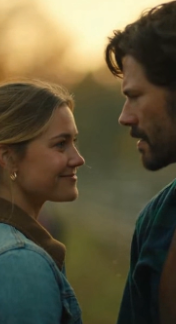
FULL STORY:
The morning it happened, I was fixing the carburetor on my ’94 Ford Ranger.
That’s the kind of detail that stays with you—not because it matters, but because it’s the last ordinary thing. The last moment before the world you thought you lived in got quietly folded up and replaced with a different one. I had grease on my knuckles and a cold cup of coffee balanced on the workbench and the radio playing something low and country, and outside the workshop window the October light was doing that thing it does in Tennessee where it looks like the world got dipped in honey.
Claire was on the porch. I could see her through the window—the pale blue of her flannel, her hair up the way she wore it on weekday mornings, one foot tucked under her on the porch swing, reading. Or pretending to read. I know the difference now. I didn’t then.
That’s the part that lives in my chest like a splinter: how much I didn’t know.
We’d been married six years. Met at a county fair in Cookeville, of all places—she was there with a friend, I was there with my brother Dale, and she dropped a snow cone on my boots and turned around to apologize and I forgot what I was going to say for about four seconds, which had never happened to me before and hasn’t happened since. We dated for eleven months. Got married in my mother’s backyard under a rented tent. Moved into this house—my grandfather’s house, two acres, a workshop, a chicken coop, a garden that Claire turned from a patch of weeds into something that made the neighbors slow down when they drove past.
I knew she was private. That’s not a secret I kept from myself. Claire didn’t talk about her family—not in the casual, offhand way that people with normal families do. No Christmas stories. No childhood home to drive past. No parents to visit on holidays. She’d told me early on, simply and without drama, that she’d had a difficult upbringing and that she’d made peace with it by leaving it behind. I respected that. I’d met people with hard histories before. I knew that sometimes the most loving thing you can do is not ask.
So I didn’t ask.
Six years. I didn’t ask.
I heard the engines before I saw them.
That’s the thing about living on a road like ours—you know every vehicle by sound. Dale’s truck, the Hendersons’ tractor, the FedEx van that always slows down too fast. This sound was wrong. Too smooth. Too many of them. I set down the wrench and looked out the window.
Three black SUVs. The kind with tinted windows and clean wheel wells that had never met a dirt road before today. Moving slow down our road like a funeral procession. No plates I recognized. No reason for them to be here.
They stopped in front of our gate.
I watched the doors open. Men in dark suits—four, five, I lost count. Moving with a practiced quietness, spreading out without being told. And then the last door, the rear door of the middle vehicle, opened, and a man got out who didn’t fit anything about where we lived or who we were.
Older. Sixty-five, maybe seventy. Silver hair swept back from a face that had been handsome once and was now something more than handsome—composed, expensive, the kind of face that had spent decades in rooms where the lighting was good and the stakes were high. His coat was charcoal gray and it moved the way fabric moves when it costs more than your truck. He stood at our gate and looked at the house and for a moment didn’t move.
Then he looked at the porch.
At Claire.
I was already out of the workshop before I’d decided to move.
I crossed the yard at a pace that wasn’t quite running but wasn’t walking either, and I noticed two things: Claire hadn’t stood up from the porch swing, but she’d set her book down. And the posture she was sitting in—straight, shoulders back, feet flat on the floor—was not the posture of a woman watching a stranger pull up to her house. It was the posture of a woman who had been waiting for something and was now deciding how to receive it.
The silver-haired man opened our gate. Didn’t knock, didn’t call out, just opened it and walked through like the gate was a formality he was choosing to observe. His men stayed at the vehicles. Whatever this was, he’d decided it was something he had to do himself.
He stopped at the bottom of the porch steps.
“Claire.”
The way he said her name. I don’t have a word for it exactly. Steady, yes. Controlled, yes. But something strained beneath it, the way a bridge sounds steady until you put enough weight on it and you hear the metal sing. He said her name like he’d been practicing saying it for a very long time.
Claire looked at him for a moment that stretched.
“Mr. Whitmore,” she said.
Barely above a whisper. But not afraid—that’s the thing I would keep coming back to for weeks afterward. Not afraid. Something more complicated than fear. Something that sounded, if I’m being honest, like a woman acknowledging a debt she’d always known she’d have to face.
“It took us a long time to find you,” the man said.
I walked across the yard and stood beside my wife.
I want to be clear: I did not understand what was happening. I understood almost nothing. I did not know who this man was, or why three black SUVs had come down our road, or what history was folding itself out between these two people on my porch. I understood that my wife had gone very still and that the air had changed the way it changes before weather and that whatever this was, it was real and it was large and it had been here long before I arrived.
I took Claire’s hand.
She gripped mine so hard I felt the bones shift.
I heard a door open somewhere to our left—the Hendersons. Then another, further down. By the time I looked up, there were people on porches up and down our road. Quietly, without discussion, the way communities do sometimes when something is happening that they don’t understand but recognize as significant. Our neighbors. People who’d brought us food when I had my appendix out two years ago. People whose kids had helped Claire plant her tomatoes. Watching.
The silver-haired man—Whitmore—looked at me for the first time. A measuring look. Not hostile. More like a man recalibrating.
“And you are,” he said.
“Her husband,” I said. “Tom Aldridge.” I didn’t offer my hand.
He nodded. Like that was information he was adding to a file. “Mr. Aldridge. Your wife and I have some things to discuss.”
“Anything you need to say to my wife,” I said carefully, “you can say with me standing here.”
He looked at Claire.
And Claire—my Claire, who never backed down from anything, who once told a county commissioner exactly where he could put his re-zoning proposal at a public meeting and did it in two sentences—looked back at him with an expression I had never seen on her face in six years of marriage.
“Tom,” she said softly. “It’s okay.”
“Claire—”
“I’ll explain everything.” She turned her face toward me, and what I saw there was the thing I would spend the next three days turning over in my mind. Not guilt, exactly. Not fear. Something older and more tired than either. The look of a person who has been carrying something heavy for a very long time and is finally—finally—standing at the place where they have to set it down. “I promise. I’ll explain everything. But Tom—” her voice caught just once, just for a half-second, before she locked it back down. “I need you to know that everything I told you about who I am—it’s all true. That part is all true.”
I didn’t move.
“Give me an hour,” she said. “Please.”
I looked at her for a long time. I looked at Whitmore. I looked at the men by the SUVs, the watching neighbors, the garden with the last of the fall tomatoes still on the vine.
I went inside. I sat at the kitchen table. I put my hands flat on the surface and I waited.
The conversation on the porch lasted forty-seven minutes. I know because I watched the clock on the microwave for every single one of them. I heard voices but not words—Whitmore’s measured cadences, Claire’s lower and faster, the back-and-forth of people who have a real history, complicated and unresolved. Once, a silence so long I nearly stood up. Then Claire’s voice again, quiet and firm.
Whitmore left without coming inside.
I watched through the kitchen window as his men opened the gate for him, as the three SUVs backed around in the road with more grace than you’d expect, as they drove away and disappeared around the bend, and then the street was just the street again—except for the neighbors still on their porches, who slowly, one by one, went back inside the way people do when they’ve witnessed something they’ve decided is private.
Claire came in and sat down across from me at the kitchen table.
She was quiet for a moment. Not composing herself—she was already composed, with the particular composure of someone who has been composed for so long it has become structural. She was quiet the way someone is quiet when they’re deciding where to begin.
“His name is Gerald Whitmore,” she said. “He’s the third wealthiest man in the state of Georgia.”
I waited.
“He’s also my father.”
The kitchen was very still.
“I left seven years ago,” she said. “Two years before I met you. I didn’t—I didn’t stage it or plan it like some dramatic thing. I just stopped. Stopped going back. Stopped answering. Changed my number. Moved three times.” She looked at her hands. “Changed my last name, technically—not legally at first, but he could have found me before now if he’d tried harder. I think for the first few years he was—” she paused, “—too proud to look. And then too proud to admit he’d looked.”
“Claire,” I said. Her name in my mouth felt slightly different, suddenly. Not wrong. Just—three-dimensional in a way it hadn’t been before.
“I know,” she said.
“I need you to tell me why,” I said.
And she did.
She talked for two hours. I sat there with my cold coffee and my grease-stained hands and I listened to the story of a woman I had thought I knew reconstruct herself in front of me into someone I actually knew—and the strange thing, the thing that I have tried to explain to my brother Dale and my mother and have never quite gotten right, is that she was more herself at the end of those two hours than she had been before. Like watching a photograph develop. The person had always been there. The resolution just got better.
Gerald Whitmore was a man who had spent his entire life treating people as extensions of his will. His wife—Claire’s mother, who had died when Claire was twelve—had not been exempt from this. Neither were his employees, his business partners, his lawyers, or his children. He loved them, in his way. Claire has always said that and has never taken it back. He loved them the way a man loves things that belong to him. Completely. Ferociously. Without any particular interest in whether the belonging was mutual.
Claire was twenty-six when she left. She had been working for him—in his company, in the specific role he’d designed for her, reporting to people he’d chosen, advancing at the pace he’d approved. She’d had a fiancé he’d introduced her to, vetted, and, she said with a flatness that told me everything, strongly preferred over any alternative she might have generated herself. She had lived, as she put it, inside a story he had written, and she had been so deep inside it for so long that she couldn’t always tell which parts of herself were hers and which parts were load-bearing walls of his construction.
“I didn’t run because I hated him,” she said. “I want you to understand that. I ran because I was disappearing. And I thought if I stayed one more year I would disappear completely and I’d never even know it.”
“And today?” I asked.
She was quiet.
“His wife—his second wife, Margaret—she’s sick.” Claire folded her hands on the table. “She’s been asking for me. Apparently for a while now.” A pause. “He came himself because he knew if he sent someone I’d know how to handle it. He thought if he came—”
“He thought it would mean something,” I said.
She looked at me.
“Did it?” I asked.
The longest pause of the morning.
“Yes,” she said. “I hate that it did. But yes.”
We sat with that for a while.
I’m not going to tell you I handled it perfectly. I didn’t. I spent two days working through something that was not quite anger and not quite grief—more like the vertigo of realizing that the ground you’ve been standing on was real ground, just with more underneath it than you’d been told. I had questions I asked that I shouldn’t have asked the way I asked them. I had one night where I drove to Dale’s house and sat in his living room for three hours without explaining why and he let me, because he’s good that way.
But here is the thing I kept coming back to. The thing Claire had said on the porch before I went inside.
Everything I told you about who I am—it’s all true.
And it was. I went through it—not to check her, but to hold it up to the light and see if it held. The woman who planted a garden big enough to give away half of it. The woman who drove forty minutes to sit with our neighbor Helen after her husband died because Helen had mentioned once, months earlier, being afraid of being alone. The woman who laughed at my terrible jokes with a generosity I’d never taken for granted. The woman who had, six years ago, dropped a snow cone on my boots and looked at me like she was genuinely sorry about something small in a world full of large things.
None of that was his story. All of that was hers. All of that was mine.
She visited Margaret Whitmore in Atlanta six weeks later. I drove her. Waited in the hospital lobby for four hours reading a three-month-old Sports Illustrated. She came out looking like someone who had set something down that she’d been carrying for so long she’d forgotten the weight of it.
Gerald Whitmore met me in the lobby on the way out.
He looked at me for a moment—that same measuring look from the porch.
“She did well,” he said. “For herself.”
It wasn’t an apology. I don’t think it was designed to be. But I’ve turned it over enough times that I think it was the closest he knew how to get.
“Yes,” I said. “She did.”
We drove home in the dark with the radio on low, Claire’s hand on the center console, my hand on top of it. The Tennessee hills passing outside the window, black against a blacker sky.
“Thank you,” she said, somewhere around Cookeville. “For standing beside me before you knew anything.”
I thought about it.
“You would’ve done the same,” I said.
She was quiet for a second.
“I would have,” she said. “But it still mattered.”
Some things you know about your marriage from the beginning. Some things you have to earn. We drove the rest of the way home in the kind of silence that isn’t empty—the kind that has furniture in it, and light.
I still have grease on that workbench. The carburetor never got finished.
Someday I’ll get back to it.
Leave a Reply