FULL STORY:
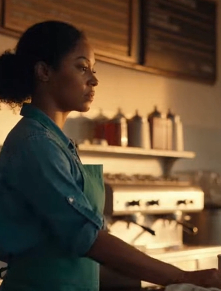
Felicity Brown had a system for the hard days.
On the days when the dishwasher broke and the morning cook called out sick and the register stuck on the third transaction and her feet started aching before the lunch rush had even peaked — on those days, she made herself a single cup of coffee, stood at the end of the counter for exactly ninety seconds, and looked out the front window of the Sunrise Diner at the street outside.
Not because the street was beautiful. East Cleveland in late September was not a postcard. The buildings across from her were the color of old concrete and older mistakes, the sidewalk was cracked in three places she’d been meaning to report for two years, and the bus that ran past every forty minutes smelled like diesel and whatever the previous decade had left behind.
But the street was real. The street was hers. She had grown up four blocks from this diner. She had walked to school past it, and worked summer jobs near it, and come back to it after two years in Columbus that had gone sideways in ways she didn’t talk about anymore. She had walked through its door at twenty-seven with a food handler’s permit, a strong back, and no particular plan — and somehow, eight years later, she was still here. Still behind this counter. Still wiping it down at the end of every shift with the same blue cloth that always seemed to need replacing and somehow never quite did.
She was thirty-five years old and she was tired most of the time and she loved this diner with a fierceness that embarrassed her when she thought about it too directly.
It wasn’t what she had planned. But it was what she had built. And there was a dignity in built things that planned things sometimes lacked.
Marcus had first come in on a Thursday in late March.
She remembered because Thursdays were her doubles — open to close, twelve-hour shifts that left her with a specific variety of exhaustion that only Thursday doubles produced — and because he had come in during the slow hour between lunch and dinner when the diner was almost empty and the afternoon light came through the windows at a low angle that made everything look a little more melancholy than it actually was.
He was old. That was her first impression — simply, plainly old. Not ancient, but the kind of old that had arrived after considerable difficulty. His clothes were clean but worn in ways that suggested they had been worn a long time. His shoes were carefully maintained — the kind of careful maintenance that means you have one good pair and you intend to keep them. He moved slowly, with the deliberateness of a man whose body no longer did what it was asked without negotiation.
He sat at the counter — the far end, near the window, away from the other two customers. He looked at the menu for a long time.
Felicity came over.
“What can I get you?”
He looked up. He had dark brown eyes, deep-set, and something behind them that she couldn’t name yet — a heaviness that went beyond tiredness. The look of a man who had set something down a long time ago and hadn’t entirely decided whether to pick it back up.
“What’s good?” he asked.
It was a simple question. But he asked it like he meant it — like he genuinely wanted to know, like the answer mattered to him. She liked that.
“Depends on what you need,” she said. “If you’re cold, the soup. If you’re tired, the pot roast. If you want something that’ll remind you life isn’t totally miserable, the peach cobbler.”
He considered this with more seriousness than she expected.
“All three,” he said.
She raised an eyebrow.
“Big appetite?”
“No,” he said. “Just haven’t had someone describe food that way in a long time.”
She brought him the soup first, then the pot roast, then the cobbler. She refilled his water twice without being asked. She left him alone when he seemed to want it and checked on him when he seemed like he might not. She had been doing this long enough that she had developed a kind of fluency in which people needed which kind of attention — and Marcus, she could tell, was a man who needed to be seen without being examined.
When he left, he paid in exact cash, counted carefully, and left a tip that was more than she expected from a man in worn shoes.
He said, on his way out: “Thank you, Felicity.” He had read her name from her tag, but he said it like he was saying something he meant.
“Come back,” she said. Meaning it.
He did.
He came back the following Thursday. Then the Thursday after that. Then twice in the same week, which surprised her. By June he was coming in four times a week — Tuesday and Thursday for sure, and then two other days that varied, as if his schedule was governed by something unpredictable.
They talked more as the weeks went on. Not deeply at first — weather, neighborhood, the kind of small talk that is actually a form of reconnaissance, two people learning whether they can trust each other without admitting that’s what they’re doing.
She learned things slowly, the way you learn things from a person who isn’t quite ready to tell you them yet.
His name was Marcus Wallace. He was seventy-one years old. He had worked for forty years as an electrical engineer — “Good work,” he said, “the kind where something broke and you fixed it and it stayed fixed.” He had retired eight years ago. He had been married for thirty-four years to a woman named Gloria who had died of a stroke three winters back.
“I’m sorry,” Felicity said, when he told her this.
“She was something,” he said. Just that. But the way he said it contained more than most eulogies.
He had grown up in East Cleveland — four blocks from where the diner stood, as it turned out. He had left at eighteen and built a life elsewhere and come back last year for reasons he didn’t name at first.
She didn’t ask. She had learned that some reasons were like packages left on a doorstep — they’d tell you what they were when they were ready.
It was a Tuesday in July, the hot thick kind of Tuesday that makes the city feel like it’s breathing through a wet cloth, when he came in and sat at his usual spot and ordered his usual soup — he had a usual now, which felt significant somehow — and looked out the window for a long time before he spoke.
“My son lives here,” he said. “In Cleveland. Thirty minutes from here.”
Felicity was refilling his water. She didn’t say anything, because she had learned that Marcus spoke in the pauses between sentences as much as in the sentences themselves.
“That’s why I came back,” he said. “After Gloria died, I thought — I thought it was time. That I’d been stubborn long enough.” He turned the water glass in his hands. “We haven’t spoken in nine years.”
“What happened?” she asked. Gently.
He was quiet for a moment. “Pride,” he said finally. “On both sides. The kind that feels like principle while you’re doing it and looks like foolishness later.” He paused. “He became very successful. Made more money than I’d ever imagined for either of us. And I—” He stopped. “I was not gracious about it. I had ideas about what I’d provided for him, what I was owed. And he had ideas about what I’d withheld from him, what he was owed. And neither of us was entirely wrong, and neither of us could see past our own version of the story.”
Felicity thought about this. “And now?”
“Now I’m here. Four blocks from where I grew up.” He looked out the window. “I drove past his house twice. I sat outside it once, for two hours.” He shook his head slightly. “I haven’t been able to get out of the car.”
She didn’t say anything for a moment.
Then she set down the water pitcher and leaned against the counter and said: “Marcus. What are you afraid of?”
He looked at her. Surprised, perhaps, by the directness.
“That he won’t want to hear it,” he said. “What I need to say.”
“And what do you need to say?”
A long pause. The diner hummed around them — distant dish sounds, the murmur of the couple at table four, the soft jazz from the old speaker in the corner.
“That I’m proud of him,” Marcus said. “That I’ve always been proud of him. That I didn’t know how to say it when it mattered and by the time I figured it out, the silence had gotten too heavy to lift.” He looked down at his soup. “That I’m sorry. That I need him to know I’m sorry before—” He stopped.
Felicity waited.
“Before I run out of time to say it,” he finished quietly.
She stood there for a moment, not saying anything, feeling the weight of what he’d just handed her — not handing it back, just holding it, which is sometimes the most useful thing one person can do for another.
“You should go to his door,” she said. “Sitting outside in a car isn’t trying. Going to the door is trying.”
He nodded slowly. As if he knew this. As if he had always known this and needed someone outside his own head to confirm it.
“Maybe,” he said.
He came back Thursday. He didn’t say whether he’d gone.
By August, she was setting his place before he arrived on the days she expected him. Coffee, because he always wanted coffee. Water, because she knew he didn’t ask for it but would drink it when it was there. A small dish of the crackers he liked with his soup, because she’d noticed he always reached for them before they were offered.
She didn’t think about it as special treatment. She thought about it the way she thought about all the small adjustments she made for regular customers — this one liked her pie warm, that one needed the music turned down, this other one needed to be checked on more often because he came in alone and sometimes alone is fine and sometimes alone is the kind that aches.
Marcus, she had figured out, was both kinds alternately. Some days he came in and sat in the good quiet of a person who is at peace with their own company. Other days he sat in the other quiet — the kind that means the world has gotten very small and he wasn’t sure where the walls were anymore.
On the second kind of days, she talked to him more. She told him things about herself — not because she was naturally confessional, but because she had discovered that sometimes the most useful thing you can give a lonely person isn’t attention but the opportunity to witness someone else’s life. It pulls you outward. It reminds you that other people have weight too, and that weight is something you share rather than carry alone.
She told him about Columbus — not all of it, but enough. A man she had trusted who had turned out not to be trustworthy. A year that had taken more from her than she’d had to give. Coming home not as a defeat, she had decided, but as a recalibration. Coming back to the neighborhood and finding that the neighborhood had been waiting, indifferent and patient, the way places wait.
“Home is complicated,” Marcus said.
“Yeah,” she agreed. “But it’s still home.”
He looked at her for a moment.
“How did you figure that out?” he said. “The coming back part. How did you make peace with it?”
She thought about it honestly. “I decided that the story I told about it was up to me,” she said. “I could tell it as a failure or I could tell it as a choice. Both were kind of true. I just decided which one I wanted to live inside.”
He was quiet for a long time.
“That’s harder than it sounds,” he said.
“Yes,” she said. “But so is sitting in a car outside your son’s house.”
He almost smiled. It was the closest thing to a smile she’d seen from him in five months.
In September, things shifted.
He came in on a Wednesday — not his usual day — and he was different. There was something in him that had changed, some internal weather that had broken or resolved. He sat down and ordered his soup and his coffee and he looked at her across the counter with those deep-set eyes and he said:
“I went to his door.”
Felicity set down what she was doing.
“And?”
“He wasn’t home,” Marcus said. “Or he was home and he didn’t answer. I don’t know which.”
“What did you do?”
“I wrote a letter. Left it in his mailbox.” He looked down. “I said everything I’ve been trying to say for nine years. I don’t know if it was well-written. I don’t know if I said it right. But I said it.”
Felicity felt something loosen in her chest. “Marcus. That’s—”
“I don’t know if he’ll respond,” he said quickly, as if he needed to say this before she offered him a hope that might not hold.
“I know,” she said. “But you went to the door.”
He nodded.
“You went to the door,” she said again, because she wanted him to hear it twice.
He stirred his coffee.
“I didn’t sleep much last night,” he said. “But it wasn’t the bad kind of not sleeping. It was the kind where your head is too busy with things you’ve needed to think about for a long time.” He looked up. “You know that kind?”
“Yeah,” she said. “That’s the kind where you’re actually living instead of just sitting still.”
He nodded slowly. Then he looked at his soup and picked up his spoon and she watched him eat with something that looked, for the first time since she’d known him, like appetite.
He didn’t come in the following Thursday.
Or the Thursday after.
She told herself there were explanations. Health. Appointments. The unpredictable rhythms of a seventy-one-year-old man’s schedule. She told herself this and mostly believed it, in the way you mostly believe things you need to believe to get through a shift.
The third week, she asked Darnell, the cook, to save her some of the pot roast — Marcus’s favorite — at the end of the day. She put it in a container in the back of the fridge where she could see it. A small act that meant nothing practical and that she did anyway.
The fourth week, she stopped saving the pot roast.
She did not talk about this. She had no framework for what it meant to miss someone you served food to — someone who owed you nothing and to whom you owed nothing, someone whose last name you had only recently learned, someone who had walked into your diner one March afternoon and sat at the far end of the counter and asked what was good and somehow, without either of you meaning to, had become a person you cared about.
She had not been told that this was something that would happen when she came back to East Cleveland. She had not been warned that caring would sneak up on her like that, through soup and crackers and the slow weeks of someone else’s story.
But here she was.
It was a Tuesday in late October — a full six weeks since she’d last seen Marcus — when it happened.
The afternoon was settling into the slow hour. She had five tables scattered and a counter with two regulars and Darnell was starting the prep for dinner and the jazz from the corner speaker was doing the thing it did in late afternoon where it sounded more like a memory of music than actual music.
She was wiping down the counter. The blue cloth. The familiar motion.
She was thinking about whether to order more napkins before the weekend rush when she saw, through the front window, the first black SUV pull up to the curb.
She stopped wiping.
The second one pulled in behind it.
The third one parked across the street.
They were not the kind of vehicles that belonged on this block. They were not the kind of vehicles that belonged in this neighborhood at all — too new, too large, too aggressively well-maintained, the kind of machines that existed in a different economic register entirely. Tinted windows. They sat at the curb with their engines running for a moment, and the diner went strangely quiet — conversations pausing, forks lowering, heads turning, the way people respond when something outside the expected vocabulary of their environment appears without explanation.
Felicity’s hand had gone still on the counter.
The engines cut off.
Silence. Two full seconds of it — pure, clean, the kind that presses slightly on your ears.
Then: a car door.
Footsteps.
The diner door opened.
The man who stepped through it was in his late fifties. Tall, broad-shouldered, wearing a suit that cost more than most months of her rent. Dark skin, close-cut silver at his temples, a face that was composed with the precision of a person who had learned to control what it showed and had been doing so for a long time. Behind him, two other men in dark suits moved to positions near the door without anyone telling them to — the particular choreography of professional security.
The man’s eyes swept the diner. Methodical. Not suspicious — more like a person who has learned to read rooms quickly and is doing it automatically.
Then his eyes found her.
He walked toward the counter.
Felicity felt her breath adjust. She stood very still. He was not frightening — there was nothing aggressive in him, nothing threatening. But his presence was enormous in a way that was not about size. It was the presence of a person who had, through some combination of will and work and possibly suffering, become someone who took up a particular kind of space in rooms.
He reached the counter.
“Are you Felicity Brown?”
His voice was measured. Controlled. But there was something beneath the control — something effortful about the composure, as if this moment had cost him something he hadn’t fully accounted for.
“Yes?” Her hand went to her chest without her deciding to do it.
“My name is Aaron Wallace.” He held her gaze steadily. “I’m the man you’ve been feeding for the past six months. Marcus is my father.”
The diner did not gasp. But it went the particular kind of quiet that means everyone in a room has just become one large, collective ear.
Felicity’s hand moved to her mouth.
She said nothing. She couldn’t. Something was moving through her — a cascade of things — understanding arriving a beat before she could process it, emotion arriving two beats behind that.
“I received a letter from him three weeks ago,” Aaron said. “After nine years of silence. A letter that he left in my mailbox.” He paused. The composure held, but barely. She could see the effort of it in the muscles around his jaw. “He told me things in that letter that I didn’t know he was capable of saying. Things I had stopped believing he would ever say.” Another pause. “He also mentioned, in the letter, a woman at a diner four blocks from where he grew up. He said she was the reason he finally went to the door.”
Felicity’s eyes were filling. She blinked.
“I need to thank you,” Aaron said. He said it plainly — not dramatically, not performatively, with the directness of a man who had decided to say what he meant. “For seeing him when I couldn’t see him. For caring for him when his own family—” His voice caught, briefly. He steadied it. “When his own family had let too many years go by.”
“I was just—” she started.
“I know,” he said. “He told me that too. That you weren’t doing it for anything. That you just did it.” He looked at her with something in his face that was very close to awe. “Do you understand how rare that is? To just do something kind because the person in front of you needs it, with no transaction attached to it?”
She shook her head slightly — not disagreeing, just not knowing what to do with this.
“Where is he?” she said. Her voice had gone rough at the edges. “Is he okay? He stopped coming in and I—”
“He’s in the hospital,” Aaron said.
Her hand tightened on the counter.
“He’s stable,” Aaron said quickly, reading her face. “He had a cardiac event six weeks ago. He’s—” He paused. “He’s recovering. It’s slow. But the doctors are hopeful.”
Six weeks ago. The last time she’d seen him. The day he came in on a Wednesday with his face different, with something resolved in him, and told her he’d gone to the door.
“He went to your door,” she said softly. “And then he—”
“Went to the hospital two days later,” Aaron said. “Yes.” He was quiet for a moment. “I got the letter the day before he collapsed. I read it three times sitting in my car in my parking garage. I was — I was going to call him. I was working up to calling him.” He stopped. “Then my assistant told me he was in the hospital.”
The silence between them was full of things — the weight of near misses, of timing that had no mercy in it, of years that can’t be returned.
“He’s asking for you,” Aaron said. “That’s the other reason I’m here. He woke up yesterday and his second sentence — after asking whether the nurses could turn down the television — was asking whether anyone had told Felicity at the Sunrise Diner that he was okay.” He looked at her steadily. “He said you’d be worried.”
She pressed her lips together.
She was not a crier. She had not cried in this diner, not in eight years — not on the hard days, not on the very hard days, not even when her grandmother passed eighteen months ago and she’d worked an open-to-close shift the next day because moving was easier than stillness. She was not a crier.
She was crying now.
Not loudly. Not dramatically. The kind of crying that happens when something you’ve been carrying turns out to be heavier than you knew — when it’s set down by someone else’s hands and you feel the relief of it.
“I’m sorry,” she said.
“No,” Aaron said. Quietly but firmly. “Please don’t apologize.”
She wiped her eyes with the back of her hand. Took a breath. Straightened.
Aaron reached into the inside pocket of his jacket.
The diner — which had been attempting to pretend it wasn’t listening, with limited success — shifted again. Slightly forward. The collective lean of people waiting for what happens next.
He placed an envelope on the counter.
“My father wanted you to have this,” he said. “He asked me to bring it personally. He was very specific that it be personal — not mailed, not sent through anyone else. Personal.” He paused. “He was very specific about a lot of things, as it turns out, when he decided to start being specific.”
Felicity looked at the envelope. Her name was written on it in a handwriting she recognized — careful, deliberate, the handwriting of someone who had been taught that letters mattered and had never unlearned it.
She didn’t open it yet.
“How is he?” she said. “Really. Not the hospital-speak version.”
Aaron considered her for a moment. Then he said: “He’s tired. And he’s lighter. Both at the same time.” He paused. “I’ve been at that hospital every day for six weeks. I’ve talked to him more in six weeks than in the previous nine years combined.” Something moved through his face — complicated, layered. “He’s not the man I was angry at. Or — he is. But he’s also more than that man. He’s become more than that man.”
“He was always more than that man,” Felicity said. “He just needed someone to remind him.”
Aaron was quiet for a moment.
“Yes,” he said. “I’m starting to understand that.”
He looked at her with those dark, deep-set eyes that were so much like his father’s it was almost impossible to look at them directly.
“He can have visitors,” he said. “He’s asked for you specifically. If you’d like to come.”
She nodded. She did not trust her voice quite enough for words yet.
Aaron reached into his jacket again and placed a business card on the counter beside the envelope. “My number. Call when you’re ready and I’ll arrange a car.”
She looked at the card. At the name: Aaron Wallace, Wallace Enterprises. At the number beneath it.
“I can drive myself,” she said.
He almost smiled. “He said you’d say that.”
She looked up.
“He said,” Aaron continued, with something that had softened in him, “‘She’ll say she can drive herself. Let her. She doesn’t like to feel managed.’”
Felicity stood there for a moment.
“He paid attention,” she said softly. Not quite to Aaron. More to herself — to the version of herself that had spent six months serving soup and pot roast and peach cobbler and conversations to a man she thought she was simply being kind to, not understanding that kindness, when it is given freely and consistently and without expectation of return, has a weight to it. That it registers. That it is remembered.
“He paid very close attention,” Aaron said. “According to him, you are—” He glanced down briefly, as if consulting his memory of exact words. “The kind of person who makes a place feel like it’s worth being in.”
The jazz from the corner speaker drifted through the diner. Someone at a back table quietly resumed their conversation. The late afternoon light, going golden and low, fell through the windows and lay across the counter, across the envelope with her name on it, across two people standing on either side of a counter in East Cleveland having a conversation that neither of them had expected to be having.
“I’ll come tomorrow morning,” Felicity said. “After the breakfast rush.”
Aaron nodded. He held out his hand.
She shook it.
“Thank you,” he said. “For what you did for him.”
“He did something for me too,” she said. “People always think kindness only goes one direction.”
Aaron looked at her.
“What did he do for you?”
She thought about it. About the last eight months. About the man with the careful shoes who had come in during the slow hour and asked what was good like the answer truly mattered. About the weeks of Tuesdays and Thursdays. About the slow revelation of a story she hadn’t asked to hear and had received like a gift anyway — the story of a man and a son and a silence and a letter and a doorstep.
About how you can spend years in a place, doing the same work with the same blue cloth, thinking you are simply surviving — and then someone sits down at the far end of your counter and reminds you, without meaning to, that you are also, quietly, irreplaceably, yourself.
“He reminded me that showing up is enough,” she said. “You don’t have to fix things. You don’t have to have the answers. You just have to keep showing up.”
Aaron was quiet for a long moment.
Then he said: “I’m going to tell him you said that.”
“Tell him I’ll see him in the morning,” she said. “Tell him to save his appetite. I’m bringing soup.”
For the first time since he’d walked through the door, Aaron Wallace — fifty-eight years old, CEO of a privately held company with offices in four cities, a man who had learned to maintain composure in rooms that were specifically designed to destabilize it — smiled. A full smile. The kind that reached the deep-set eyes he had inherited from his father.
“He’ll like that,” he said.
He turned. He walked back through the diner, past the tables of people who had stopped pretending not to watch and weren’t pretending anymore. His two security men fell into step behind him. The door opened. They went out into the afternoon.
Through the window, Felicity watched the three black SUVs pull away from the curb. One by one. Back into whatever version of the city they’d come from, back into the part of the world that existed in a different register than this diner, these cracked sidewalks, this late September light.
She stood at the window for a moment after they were gone.
Then she picked up the envelope.
Her name on the front. Marcus’s handwriting — careful, deliberate.
She opened it.
Inside was a letter. Three pages, handwritten, the same careful script. She would read it tonight, at home, with Tuesday the cat on her lap and a cup of tea going cold beside her.
She would read it twice.
Then she would fold it and put it in the same drawer where she kept the things she needed to keep — the three good photographs, the card from her grandmother’s funeral, the note from her first day at the Sunrise Diner that her manager had written: You’re going to be fine here.
She would put it with the things she kept.
She went back to the counter. Picked up the blue cloth.
Darnell’s head appeared from the kitchen window. He was fifty-two years old and had worked at the Sunrise Diner for fourteen years and was not, as a rule, a man who commented on things that were not his business.
“Everything all right?” he said.
She looked up.
“Yeah,” she said. And then, because it was true and because true things deserved to be said out loud: “Yeah. Everything’s good.”
She wiped down the counter.
The jazz played from the corner speaker.
The late afternoon light continued its slow gold progress across the floor.
Somewhere across the city, in a hospital room, an old man was awake and lighter and asking about the woman at the diner four blocks from where he grew up — the woman who had set his place before he arrived and talked to him on the hard days and told him to go to the door.
She would see him in the morning.
She would bring soup.
She kept wiping the counter.
Leave a Reply